- New Spyder version enlarges Huracán family
- Engineered for pure rear-wheel driving fun with lifestyle appeal
- New design of front and rear identifies the new model
- Naturally aspirated V10 engine outputting 580 hp
- 0-100km/h in 3.6 seconds, top speed of 319 km/h
Sant’Agata Bolognese/Los Angeles, CA, 15 November 2016 –
Automobili Lamborghini presents the Lamborghini Huracán rear-wheel drive
Spyder, combining the lifestyle appeal of the convertible with the pure
on-road experience of the Huracán’s rear-wheel drive technologies.
“The rear-wheel drive Spyder enlarges the Huracán family’s core
product range,” says Automobili Lamborghini Chairman and Chief Executive
Officer Stefano Domenicali. “It offers the lifestyle appeal of open-air
motoring with the pure thrill of rear-wheel drive engineering. This is a
Lamborghini for those with a passion for life and the purest driving
experience on the open road. It’s also a Huracán for those entering the
Lamborghini family, wanting a true Spyder experience without
compromising on the performance and dynamic handling of a rear-wheel
drive car.”
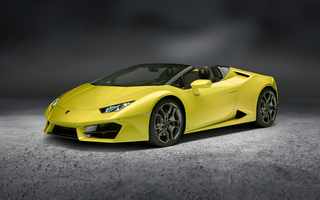
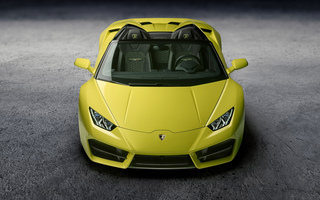
The rear-wheel drive Huracán Spyder features a newly designed
front and rear with a dynamic but more aggressive look distinguishing it
from the four-wheel drive version. Its naturally aspirated V10 5.2 l
engine sends 426 kW / 580 hp to the rear axle, with its dry weight of
just 1,509 kg providing a weight-to-power ratio of 2.6 kg/hp.
Acceleration from 0-100 km/h is achieved in 3.6 seconds with a top speed
of 319 km/h.
The rear-wheel drive Spyder will be available in markets worldwide
from January 2017, priced between the two and four-wheel drive coupe
models and completing the core Huracán product range.
Soft-top design for a true Spyder
The front and rear of the car have been redesigned, with its
dynamic good looks accented by the large front air intakes that direct
cooling air and headwind to increase down pressure on the front axle.
Pirelli PZero tires, exclusively developed for the rear-wheel drive
Huracán, sit on 19” Kari rims. Specially contoured steel brakes with
aluminum brake disc pots assist in weight reduction and improved
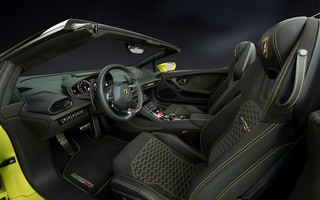
cooling. Inside, the cockpit features the latest Lamborghini
Infotainment System II with a 12.3” hi-res TFT instrument panel.
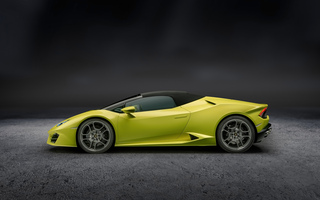
The latest addition to the Huracán family adopts the soft-top
solution of a true Spyder, distinguishing the convertible from its coupe
sibling through a unique profile, with roof both up and down. Opening
and closing in just 17 seconds at speeds of up to 50 km/h, the
lightweight soft top is efficiently stowed to maintain the Spyder’s
perfect center of gravity and highlight the dynamic design of the open
car.
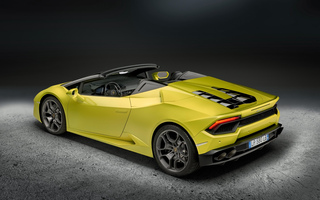
With the roof down, two distinctive fins rise out of the folding
roof-casing to perfectly define the unique lines of the open car.
Accenting the Huracán Spyder’s low, powerful appearance, the rear fins
start at the seatbacks and continue the roof line to the rear, creating
the Spyder’s flowing profile. The two fins contribute to optimizing
airflow through the engine compartment, which is covered by a slatted
engine bonnet specific to the Spyder.
An integrated duct reduces turbulence in the headroom during open
top driving. With soft top both up and down the driver can also
electronically open the rear window, which functions as a windshield
when up and highlights the V10 engine’s unique sound when down. Two
removable lateral windguards dampen lateral aerodynamic noise in the
cabin, permitting conversations even at high speeds.
Engineered for rear-wheel drive performance
As it does in the rear-wheel drive Huracán coupe, the Spyder’s V10
5.2 l naturally aspirated, mid-mounted engine provides a maximum 426 kW
(580 hp) power output at 8,000 rpm and 540 Nm of torque at 6,500 rpm,
with 75% of torque already available at 1,000 rpm.
Like the coupe, the rear-wheel drive Spyder promises the thrill of
two-wheel drive dynamics, roof up or down. Weighing 1,509 kg dry, the
rear-wheel drive Huracán Spyder achieves a weight to power ratio of just
2.6 kg/hp. The Huracán’s exceptionally stiff hybrid aluminum and carbon
fiber chassis is complemented by springs and anti-roll bars on double
wishbone suspension, optimized for two-wheel drive. The power management
system of the rear-wheel drive includes a specific steering set-up and
recalibrated stability and traction controls, connecting the driver as
directly as possible with the road. Weight distribution is biased 40% at
the front / 60% at the rear, reducing inertia on the front axle
compared to the Huracán 4WD version.
The Lamborghini Doppia Frizione (LDF) seven-speed dual clutch
architecture ensures the fastest gear changes and includes ‘launch
control’ for maximum acceleration from a standing start. The electronic
power steering and optional Lamborghini Dynamic Steering (LDS) are tuned
specifically for the rear-wheel drive Spyder, ensuring maximum agility
and control in every driving condition, depending on driving mode and
speed.
Rear kinematics heighten the car’s ‘centered’ feeling and the new
Spyder features the Lamborghini Piattaforma Inerziale (LPI), the
Huracán’s sensor system placed in the center of gravity of the car,
tracing all 3D movements. It provides real time information to the
optional Magneto Rheological Suspension (MRS), steering and stability
control systems: the ESC has been regulated to adapt to all adherence
conditions yet emphasize the rear-wheel drive behavior in each driving
mode.
The ANIMA (Adaptive Network Intelligent Management: ‘soul’ in
Italian) button on the steering wheel allows the driver to adopt
different driving modes, calibrated to suit the spirit of the rear-wheel
drive model. STRADA for daily use, SPORT for sporty driving fun, and
CORSA for maximum track-oriented performance are tuned to provide
over-steering characteristics, emphasizing authentic rear-wheel drive
behavior.
As in all Huracán models, cylinder deactivation improves engine
efficiency, reduces fuel consumption and reduces CO2. When full engine
capacity is not required, five of the ten cylinders are temporarily
deactivated by switching off one cylinder bank. When the driver
accelerates, the system switches back instantaneously to ten-cylinder
mode, with the changeover being virtually impossible to detect by the
driver.